Manifold Absolute Pressure Sensor
Almost all engine control systems that do not use an air mass sensor are equipped with an intake manifold absolute pressure sensor.
In such systems, based on the data on the pressure and air temperature in the intake manifold, the engine control unit calculates the mass of air contained in each centimeter of the cubic volume of the intake manifold. With each intake stroke, the cylinder "sucks" rarefied air from the intake manifold, the volume of which is approximately equal to the internal volume of the engine's cylinder. Knowing the internal volume of the engine cylinder (in cm3) and having previously calculated the density of the air drawn in by the cylinder (in g/cm3), the engine control unit calculates the mass of air (in grams) entering the cylinder during the intake stroke. In accordance with the calculated mass of air consumed by the engine, the engine control unit generates fuel injector control pulses of the appropriate duration, achieving the preparation of an air-fuel mixture with a composition close to the specified one.

Application:
- MAP (Manifold Absolute Pressure) sensor
- Boost pressure sensor
- Atmospheric pressure sensor
- Fuel pressure sensor
- Fuel tank pressure sensor
- Oil pressure sensor




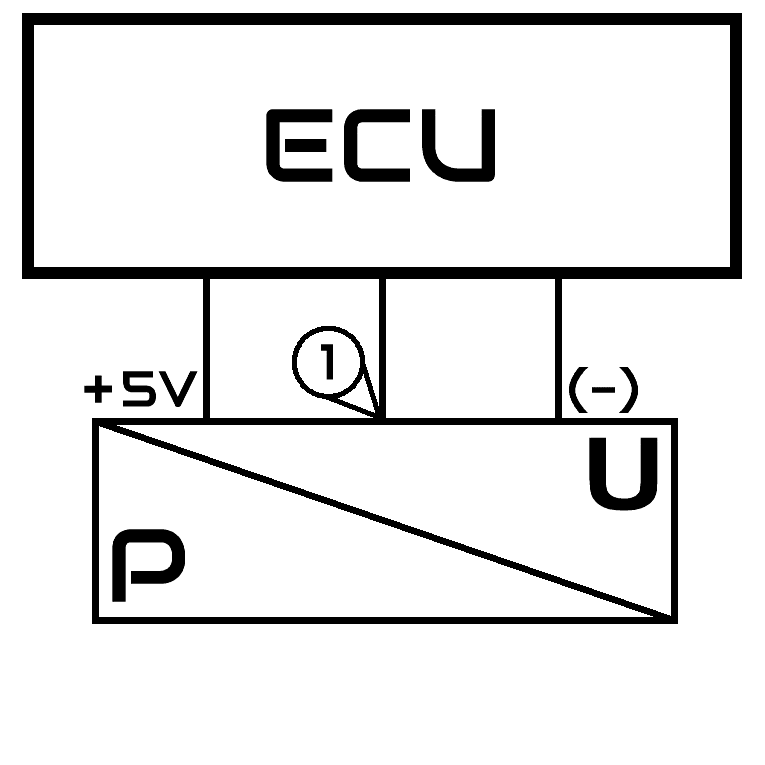
Output voltage waveform from a properly functioning MAP sensor (Mitsubishi Lancer 1.6 2005). The output voltage of the sensor decreases with increasing vacuum in the intake manifold.
A – engine start
B – running at idle
C – snap throttle (acceleration)
D – deceleration
E – running at idle
F – engine shut off

Snap throttle and deceleration